https://twitter.com/stephenfry/status/1136969939917705221
Straight pride sounds absurd, of course, but you got me thinking there, Stephen. I experienced all of those due to being a man. Perhaps I should start male pride?
And as for a comment to the actual event. Yes, it was a homophobic attack. And if it, a single assault, makes news all over the world, then it seems like we're in a really, really good place already.
The more tolerance, the less tolerance for intolerance. LGBT has support of corporations. The culture war has been won already. I have no idea why there is still a pretense to fight on either side.
Friday, 7 June 2019

Sunday, 6 January 2019

Saturday, 22 December 2018
on material memory
Memory is immaterial, and as such, it cannot be trusted. Hence, we try to materialize our memories.
The perfectly acceptable tier: how can I really know I was somewhere, if I don't have a memento from there?
Souvenirs: for a small fee, you are allowed to buy an item that proves the existence of your voyage, it may be a fridge magnet or a small elephant sold on the street by an immigrant; kitsch is welcome.
Also, (love) letters, unlike the items from the last tier, for reasons unknown. Provided you keep them well hidden.
The acceptable albeit uncommon tier: how can I really know I have eaten, if I don't save a receipt?
Those at least are free and easy to store, their problem is they still manage to generate mess, also, they get worn out. Still, it's a bit over-materializing already. You aren't supposed to arrive at a place where you would do it.
The tier for the hardcore: how can I really know I had given experience or mental state, if I don't have a hard copy referring to it on me?
Tattoos allow you to preserve whatever-you-want-to-have-preserved just like that. Just for the chosen few.
The red flag tier: how can I really know I had given experience when I'm supposed to move on?
Used condom [wrappers] and toothbrushes of your past partners. I have never heard of it, but it seems intuitively repulsive. There's something too private and physical about it. But the whole idea was about materializing the immaterial and private, it sounds exactly what we desire.
Sunday, 9 December 2018
on psychopathological dualism
So I'm watching Louis Theroux on Netflix, the episode about America's medicated kids, kids diagnosed with various psychiatric disorders. And he keeps asking, well, how much of it who the children is is due to their personality and how much is the disease's affliction.
But just as we dealt away with Cartesian dualism, we should abandon psychopathological dualism. Meaning, there is no personality suddenly overridden by an illness. There is one brain, and a mind emerging from that brain. Whatever happens, is in the soup.
I have depression in the way I have two arms. It's not that some chemicals just turned bonkers but there's some Real Me underneath, simply clouded by depression. No, it's the same eintopf. Getting rid of depression means changing who I am, not uncovering some platonic fucking ideal.
And I'm doing bad enough, that I don't mind, I don't care about whatever virtues come with depression (say, intelligence - but purely as a correlation, not a causation, there cannot be causation, see above) I don't mind being changed by the medicines or therapists, I am willing to become someone else because I just can't live with myself.
Wednesday, 5 December 2018
on reasons to stay alive
Let's imagine there are two dream jobs I have. I would like to be either a musician or a writer. I will be perfectly happy being a full-time musician. I won't mind in that case not becoming a writer. And vice-versa. On the other hand, a job as a computer scientist would not satisfy me.
Now, say I announce to be a writer. It would be odd to receive feedback along the lines of "but imagine how much you could achieve as a musician, how can you sacrifice that?"
Now, let's take it up an existential notch.
There are things I want to achieve. Pursuing them may well count as the titular reasons. And I also have a deathwish.
And the symmetry is there. If I accomplished certain goals pertaining to being alive, I wouldn't be upset about not fulfilling the drive to death. Corollary: I honestly couldn't care less about accomplishing anything in real life, if I chose to die (and the fact the dead can't care at all seems to strengthen my point). Those are two absolutely incompatible goals. I want to get better. I want to die. And I'm willing to act on either. It is that meek staying alive that is the absolute worst.
Up yours, Matt Haig.
Monday, 26 November 2018
on the maximal dose of prozac
The only effect is that I'm able to last longer, but it doesn't matter since I'm not getting any anyway.
Sunday, 18 November 2018
Saturday, 17 November 2018
Thursday, 15 November 2018
on photos
As I was going home, I walked past somebody's window and so I stole a peek inside. I saw the entire 1m x 0.5m fragment of the wall covered with photos of other people.
Whether it's a photo of you kissing that cutie in the mirror hanging over your bed, or the wallpaper of your girlfriends and you on the beach, or the photo of your loved one serving as a screen on your mobile, it marks the discrete difference between us.
It is a proof of your fundamentally humane ability to uphold relationships. It is a proof your fundamentally humane quality of being over time, connecting to your past.
I don't have either. I have no photos. The past is gone and I'm unable to see the future. It is much too overwhelming just to live in the present moment, becoming increasingly detached, because each remainder of how beyond the fringe I have gone already is too painful as it is.
And I'm not in those photos either. Just as I don't remember, I am not worthy of being remembered.
She said, they will only miss you when you're gone. No, they won't even notice.
Friday, 2 November 2018
on pride
Some time ago, there was the FIFA World Cup, featuring the national team of Poland. Their performance went according to the plan. Well, not so much: it went according to the pattern.
In the group stage, each team plays three games. And so, the pattern is:
the opening game [mecz otwarcia]
the all-in game [mecz o wszystko]
the honor game [mecz o honor]
A quick clarification: the opening game is simply so-called due to being the first that is played. This game is subsequently lost, hence it all comes down to the result of the second game: one about everything (namely, whether the team advances out of the group stage). Finally, that game also turns out to be a disgrace, so what is left is honor, basic dignity, perhaps we can win when it does not matter anymore. And we do. Last World Cup we deviated from this pattern (L-L-W) was in 1986 (well, we've only qualified for three of them ever since).
However, this year I've come across some of the international media commenting on the Polish team. They did not, however, utilize the terminology I proposed above, but a slightly different one. Namely, the last game was described by many as "playing for pride".
And with that, I disagree. Pride stands for the feeling of superiority to others. That it is a sin may not be a convincing moral evaluation, nevertheless, it seems negative in its nature.
The Polish team couldn't convince anyone of their superiority, even by winning. What they played for was basic dignity, or salvaging whatever remains were of it. They did not play for pride.
And I just fail to see the context in which pride of a mob (Polish supporters, in that instance) is a positive phenomenon. Which, of course, leads us to the most basic connotation with the word 'pride'.
It's OK to be gay (that one rhymes). But it is no valid reason for pride. You are not superior to others by the virtue of your sexuality - whether you are straight or not.
Does it take balls (pun intended) to come out? Yes, it does. But in this instance, one could feel superiority merely to those, who have been to afraid to do that. I don't think that's really the point. The pride experienced is the pride resulting from a brave act, not your sexuality`per se.
Feel free to demonstrate your sexuality, feel free to advocate for equality. Feel free to be proud of your actions, if you believe in free will. But I cannot sympathize with pride with something both abstract and independent of the agent (obvious symmetry potential, diy).
Saturday, 27 October 2018
ethics in the information age
Ethics in the Information Age
Introduction
In this essay I am going to argue that the Information Age has given rise to a range of popular phenomena, whose negative moral implications are easily overlooked. My argument is inspired by the main principle of evolutionary psychology: we have certain dispositions - including psychological ones - which have risen in the environment of evolutionary adaptedness. The thesis is twofold: first, that the newest technology has had great impact on the moral landscape, and second, that its efficiency at changing it is heavily influenced by its ability to e x p l o i t our dispositions. Of course, it is not the machines or algorithms that are responsible, but rather our own ingenuity in creating whatever serves its purpose best, regardless of the resulting harmful by-products, whether to the fabric of society or environment. In Section I, I will describe the premise behind evolutionary psychology in more detail and present the case for the relevance and importance of new technologies in that context. Next, I will present how technology is able to exploit our dispositions by the means of analysis of the following two phenomena: “virtue signalling” in Section II and moral shaming in Section III.
I. Evolutionary psychology
Evolution is the most important theory science has yet arrived at. Whether one shares this sentiment or not, there is no need to describe its mechanism in great detail. Organisms pass their genes on by the means of reproduction. Those genes which result in greater reproductive success of the specimen possessing them will be more and more common among the population with each and every next generation, until reaching fixation, that is, becoming common amongst all members. By the same calculation, the genes lowering one’s inclusive fitness will naturally die out, since the individuals possessing them are not as efficient at propagating them as the competing rest.
In the process of evolution, various adaptations have been created. Just like introducing the assembly line, where each worker specialises in only one task was a great improvement in the productivity over the model one-does-all, so we have developed distinct adaptations with very different functions. Lungs are nothing like the heart anatomically-wise and there is no reason why they should be; they have different functions and both are built in a way that manages to perform them optimally.
What evolutionary psychologists believe is that those adaptations are not restricted to the physiological traits, but include the psychological ones as well (Symons, 1992). A good example of such a psychological adaptation is one of the cheater-detection module. In 1966, the four-card problem was invented by a cognitive psychologist Peter Wason (Wason, 1968). There are four cards lying down, each has a number on one side and a letter on another. Then, a rule is given: “if there is a vowel on one side of the card, then there is an even number on the other side” and the subjects are asked which cards have to be reversed (their other side than the one visible at the moment inspected) in order to check if this rule is correct.
It is a simple task in deductive reasoning, but the results were abysmal. What is of our interest, however, is that the success rate of respondents was very heavily dependant on the context given. Two evolutionary psychologists presented a slightly different formulation of the problem, one grounded in the social relations rather than somewhat abstract objects such as signs (Cosmides & Tooby, 1992). Consider cards which have a number representing one’s age written on one side, and a drink of choice on another, and a rule “you have to be 18 in order to be able to drink alcohol”. In this case, people showed much more competence at checking whether the rule has been enforced. Furthemore, other, similar experiments took place to rule out such a possibility as one’s former awareness of the rule or cultural familiarity with it. Thus, it seems that we may have evolved what has been called a cheater-detection module: we are able to detect someone’s departure from the rule, but not so much breaking a rule when abstract objects are involved. Figuring whether the person one is communicating with is providing honest or false information has been a fundamental problem throughout our evolutionary history. Therefore, we can consider this module as a psychological adaptation.
Now, the particularly important concept is that of the environment of evolutionary adaptedness (henceforth shortened to EEA). Simply speaking, the process of our adaptations evolving was shaped by the environment where that process took place. If there had been no oxygen in the air, we would not have developed lungs. Now, it is patently obvious that our current environment is different from EEA. Of course, it is not as radical a difference as is possibly imaginable, because we simply would not have survived it: for example, consider the average temperature rising by sixty degrees. However, the evolution of culture has had massive impact on humanity, at the moment reaching the stage of the information age. Whichever adaptations we have evolved, they might have been suitable in the EEA, but there is no certainty they continue to be beneficial now or in the future. Particularly, since we see that it is not the biological sphere that has changed abruptly, but the cultural one, it is the psychological adaptations that should be under our scrutiny. And so, I claim that certain psychological adaptations we possess may have become obsolete, if not downright harmful, given our current cultural environment. It is vital to remember that “Individual organisms are best thought of as adaptation-executers rather than as fitness-maximizers” (Tooby & Cosmides, 1992).
I may be accused at this point of conflating two different evaluations. We must clearly differentiate between what is good for survival, meaning increasing inclusive fitness, and what is good in the ethical sense of the word. The adaptations of the past were good or indifferent for survival, not necessarily morally good. Now, it is only a speculation which cannot be falsified yet, that certain psychological adaptations have gone obsolete. It would require another thousands of generation to see if they will truly have atrophied, which would corroborate the hypothesis. My argument is as follows: some of our psychological adaptations motivate us to act in a way, whose utility/moral value we overestimate (I believe the reverse holds as well: we may also be deterred from acting in certain ways which we would follow if it was not for our underestimation of their value). In the following sections, I will attempt to demonstrate how technology manages to exploit these adaptations.
II. “Virtue signalling”
What is “virtue signalling”? It is a relatively new term, which has been popularised by James Bartholomew in 2015 in his article in The Spectator. The idea is fairly simple: it is a morally relevant platitude. It can take form of a corporate slogan; e.g. Whole Foods and the promotion of their motto “values matter” or your friend’s post on facebook reading “say no to X”, where X is an ideology abhorred by each and every of their friends.
The greatest paradox lies in the name of the phenomenon. I have come to the conclusion that the defining features of virtue signalling are as follows. First, it does not have much to do with virtue. Second, it is the weakest kind of signalling.
According to the classical account of virtue, it is fundamentally expressed in agent’s behaviour. We may claim that given person is virtuous based on the fact that they act virtuously. Even if virtue is treated merely as the disposition to act, it is a moot point to debate the courage of a man, who has never had an occasion to act courageously. Such a man’s pretensions to courage must ultimately be contested.
What all cases of virtue signalling have in common, on the other hand, is that they are merely platitudes, fundamentally lacking any reality-changing potential; they are m a t e r i a- l l y i n f e r t i l e. It is a morally loaded statement that is precisely uncontroversial enough not to be significant. It is not a person who opposes the totalitarian regime of their country, but a politician who claims their party cares about the poor, merely expressing certain sentiment, while the party is not necessarily helping the disenfranchised. It is a prominent website setting a special version of their logo for a single day in order to show their support to the minority celebrating on that day, just when the minority has been accepted by the society to the extent that the logo will not rise any meaningful controversy.
Signalling, on the other hand, is a term used in the field of, among others, evolutionary biology. Organisms communicate with each other, for example, in order to advertise their worth in the “reproductive market”. Such signals, however, can be either honest or dishonest. An example of a dishonest signal may be the ability to regrow a part of body that only manages to imitate the old one rather than possess any functionality of the original, e.g. a crab regrowing a claw merely to scare off its enemies. On the other hand, there are honest signals, such as a peacock’s tail. The fundamental idea is as follows: the more costly the signal to the agent signalling, the more likely it is to be honest.
A peacock that is able to develop a tail so mesmerizing that it becomes a handicap to its own functioning shows that it is strong enough that it has been able to develop such a tail in the first place, thus has better success breeding, which results in increasing his inclusive fitness by having more offsprings than other peacocks.
We could also conjure an example that is better related to our everyday, cultural life. Imagine meeting two men on the street. The first one says “I have a lot of money.” The second one invites us to his mansion, whose luxury is breathtaking. We would believe it is the latter who has much more in his bank account, precisely because his signal was reliable: it was costly. The fact that the second man has managed to spend so much in fact informs us, how much he must then have had in the first place, rather than put skepticism in us based on his extravagant spending habits. The first man’s signal, on the other hand, did not cost him anything whatsoever, and so it lacks a great deal in reliability.
It is clear that virtue signalling seems like something the former man would engage in. If there is no action behind the statement and if the statement was free to broadcast, it probably is not worth a great deal of attention. A dishonest signal, however, can still trick somebody, its expected value is still positive to the agent. Why else would anyone engage in it? The agents advertise themselves essentially at no cost, even if the advert is not particularly effective.
A case study of recent empik controversy informs us how fragile the results following this behavior are. Empik received a lot of negative feedback after it has been discovered that they sell a book on the refuted concept of treating homosexuality. Many people appealed to withdraw the book from the store, but empik did not comply. A while later, just before Parada Równości took place, empik changed its logo to a rainbow-colored version in the social media. However, surprisingly, feedback was overwhelmingly negative: not so much from those, who would protest such an initiative from any company, but precisely from the group who expressed their concern in the first situation. It was believed merely to be a “PR move” and in no way compensating for the previous misdeed. However, other companies did not receive such accusations of (in)conspicuous promotion of their own interests while engaging in similar action.
So far we have focused on the cost/benefit, signalling part, but now I would like to analyze slightly further the (in)action problem, the aspect of virtue. I want to suggest the following distinction: action vs information. I believe there has been a recent development of the latter at the cost of the former on two levels: technological and cultural.
Technology has been able to improve the rate of the flow of information staggeringly efficiently. We are able to learn what is happening in practically any place on the planet, right at the moment, at any moment. What is even more important, however, is our role in that flow: we are not merely the audience anymore, but creators as well. It is sharing, commenting and reacting that gives the actual flow to that river and what differentiates the Internet from such a medium as the television. We no longer witness anything happening before our own eyes, or before the eye of the camera, but only images that have been processed thousands of times already. We are encouraged to voice our opinion on any topic, regardless of our expertise on it, and we are more than happy to oblige.
Culturally-wise, postmodernist “end of great narratives” seems to have resulted in the corollary of what I propose to call “tyranny of small narratives”. In no way do I claim that discourse has no power to shape reality. Rather than that, I want to make an observation that never before has our speech been policed in such detail just as never before have we been so free to act in any way desired. It is the result of the struggle between freedom and security: it is believed we can be only free once we are secure, but by trying to attain security, we forgo freedom (on that struggle, but perhaps with quite different interpretation, see Bauman, 2003). By the idea of tyranny of small narratives I mean the value that we have given to information, at the cost of our appreciation for actions. Let me provide an example.
Earlier this year, an interview with a charity aiding people with Down’s syndrome was published. It received very positive feedback on the website. The interviewed people were parents of a child afflicted with Down’s themselves. Their approach is quite unusual: throughout the article, they present multiple cases when they themselves use names considered derogatory, vernacular for people afflicted with this disease. On the other hand, they also describe doing a great deal of work in order to assist those people however well they can.
When I presented that example in the bioethics class earlier this semester, it resulted however in an outrage both from the students and the professor. It is an obvious sociological point that people taking a class in bioethics are not representative for the whole society; it is uncontroversial to point at a political difference between those groups. The class I attended can be put at the end of the spectrum: one embracing the post-modernist, that is, one paying much closer attention to the narrative level. Attention one can give, however, is a scarce resource; it is a zero-sum game. If it is the narracy that is under scrutiny, then necessarily other aspects must be forgone to certain extent. Nobody bothered to ask what the charity actually does.
And thus, we arrive at the problem’s core. The newest technology encourages us to pay the ever-growing amount of attention to information, as opposed to our “traditional” way of life, which focused on the action. That tradition is much larger than merely virtue theory; it is essentially our everyday lived experience embedded by the metaphors we use (see Lakoff & Johnson, 1980). It is the valuation we give to action, and our skepticism towards the information. Consider the following metaphors:
Actions speak louder than words.
It was just cheap talk.
His words were empty.
Over this part I have been attempting to show that a radical change has taken place in our moral evaluations: more attention than ever is now paid to the language one employs rather than their actions. That leaves us with the final issue, one possibly unable to be resolved: is it a bad thing this change has occurred?
A somewhat disappointing answer I propose, one increasingly unpopular in the ever more polarizing society is: we should strive towards the golden middle between action and narration. The discovery of the language’s reality-shaping power has been invaluable. However, virtue signaling is just one of the examples of overvaluing the narrative, of undeserving forgoing the active part. This problem will be the common thread underpinning the next phenomenon as well, but it is not limited to those. Perhaps the most important example, but one far too vast to analyze here, is the ever-increasing depreciation of freedom of speech.
III. Moral shaming
In this part, I will consider the modern usage of the ancient emotion of moral outrage: one peculiarly efficient at causing distress, but hardly producing any positive effects. While moral outrage is as old as morality itself, I do not claim that the usage of this emotion was always or even most of the time justifiable in the EEA. Nevertheless, it seems to have possessed both certain value from the pragmatic point of view, strengthening the bonds between the society’s members even if at the cost of one’s liberty or happiness as well as it had natural, physical limits to it, which technology has abolished.
I have always, rather naively, believed that taboos belonged strictly to the past, and what seems to define our present times is our liberation from their shackles. The greatest two were sex and dissention on God; since sexual revolution and secularization had had taken place we have seemingly been free to discuss (practise) either. However, at the same time, new taboos have risen. Just because we can make the rational case for their existence, that they should in fact be upheld, does not mean that we are any less keen on punishing those who decide to break the taboo.
So, what is our treatment of the dissenters? We do not burn anyone at stake anymore. However, with the advent of the Internet, and the overwhelming popularity of social networks in particular, the circumstances have radically changed - not necessarily for the better. Nowadays, one can personally shun the other without any communication taking place in the so-called “real world”. There is no longer the spatial proximity required, and no need to risk one’s skin either. One does not need to look in the face of the other, but can safely detach from them, if not straightforward deny their humanity.
In order to analyze technology’s impact on the action of moral shaming, I would like to construct a pattern, according to which it is nowadays usually performed. Consider the following:
The person P publicly utters statement S.
That utterance comes to the attention of the outgroup.
The outgroup expresses their criticism of P for stating S.
The outgroup analyzes other P’s statements (the existence of S suggests there may be equally reproachable statements S’, S’’, etc. they has uttered in the past).
The outgroup punishes P.
I believe this scheme, with all of its elements, applies to most cases of the contemporary public personae’ shaming. Let us see how it is influenced by the technology First, it is person’s ability, whether at the moment desired or not, to reach the world at large; and parallely, everyone else’s ability to listen. Second, it is the rise of groups with common values and interests, no longer limited by physical distance. Third, it is the ability of others not simply to interpret another’s words, but provide personal feedback, reinterpret the text and reach the audience not less effectively. Fourth, it is the new technology’s “memory” expressed by the statement “the internet never forgets”; one’s inability to detach themselves from their past actions due to every word once put online, being saved there for a lifetime. Finally, it is also the punishment that no longer requires the spatial proximity; it often takes the form of convincing one’s boss to terminate his employee due to the controversy.
Some further comments are in place. First, our personal moral evaluation of S is i r r e l e v a n t. It does not matter in the slightest whether we would consider the person has truly done something reprehensible or not. The only factor that matters is the statement’s potential to spite the outgroup.
Second, it is not relevant how much time has passed between (1) and (2). That results in a particularly pernicious situation, due to the ever-moving Overton window: one’s statements are n o t judged in the context, but outside of it, relatively to the rules applying at the given moment. It is not even moral absolutism, because the morals are not believed to be timeless either: they are ever-evolving, and so, what is accepted today may well be shunned five years from now. It is rather overconfidence in one’s righteousness: an absolute faith in one’s moral code a t t h e m o m e n t, combined with the denial of a moral version of “lex retro non agit”. Of course, I am not saying that no one ever does wrong if his contemporaries are sanctioning it. Rather, I am protesting against taking things out of context - something both pernicious and popular.
Furthermore, it is important to analyze the already mentioned concept of an outgroup (Alexander, 2014). Given there are at least as many opinions as there are people, there exists some outgroup in regards to any single individual. However, it is vital to notice than not every outgroup is the same. First, it is safe to slander those, who have no access to the media which broadcast the message: for example, the Amish. Second, there is certain cultural proximity required in order to give rise to the outgroup proper. While Daesh is found by virtually everybody in the West to be the embodiment of evil, I want to draw attention to the following claims in the recent past both from the left: “Fox News is worse than ISIS”, “Trump is more dangerous than ISIS” and the right: “Planned Parenthood is worse than ISIS”. What explains the sentiments behind those examples is that Daesh is simply too exotic, too distant to receive the criticism one’s own compatriots get. Put in terms of religious communities, it is the heretics that are the most abhorred, those who depart from our ways, not the infidels, who have never been close to us in the first place. Hence, the outgroup with the biggest potential to partake in moral shaming is that, which (a) engages in the modern media (social networks), (b) is united under certain moral values, (c) is numerous enough in order to draw attention and (d) is culturally proximate enough to the issue at hand. When (d) fails, the outrage brings no effect, the group is unable to hand out the punishment, for example as in if the objects of the outrage are Kony or North Korea.
It is only thanks to the viral spread of information, enabled by the social media, that allows an outgroup to form instantly, even if temporarily. There is no need for an action more dedicated than expressing one’s outrage. And so we arrive at the most important feature of moral shaming. It carries benefits to the agent expressing the anger, even if at the cost to the society at whole (Crockett, 2017).
Technology manages to select for those issues which are likely to trigger the most negative reaction in given reader. We can refer to the idea of superstimuli: just like McDonald’s is able to cater for our taste better than other food at the cost of health, similarly, the media can engage in narration that the targeted group finds most upsetting. In fact, there seems to be nothing hypocritical whatsoever about producing absolutely contradicting information, given that each “tribe” engages with those that they find relevant. As a documentarian Adam Curtis simply put it, “angry people click more”. We are given a lot of content to be angry about, because we are fond of engaging with that content, due to what brings us to the former issue: the potential to signal our own reputation. We are able to experience that practically imbibing feeling of moral self-righteousness, when we engage in moral shaming ourselves. Furthermore, it turns out that expressing anger only feeds more anger rather than extinguish it (Bushman, 2002).
And there are huge costs of that behaviour to the society at large. It is not only destroying individual lives of those who have been found to have transgressed, both professional (e.g. convincing their employer to fire them) and personal (e.g. afflicting them with PTSD having sent death threats). The general problem is the further polarization of each moral tribe, where lesser and lesser dissent gets progressively more and more frowned upon. It is the decline in freedom of speech and the social capital.
Conclusions
I have attempted to analyze recent phenomena from two different perspectives: that of evolutionary philosophy/sociology and that of ethics. The first one is descriptive: it allows us to explain why things are the way they are, not necessarily committing the natural fallacy, claiming that it how things ought to be. The ethical perspective, on the other hand, has been the normative one: having explained how those phenomena have risen, I argued there have been problems with them, things are not in fact the way they ought to be. Even if one was to deny any value of the science of evolutionary psychology or refute the theory of evolution, it does not impact either the description how things are at the moment or their ethical analysis; merely an explanation of how they have come to be. I believe the technology progresses at a much faster tempo than our capability not merely to use it, but to understand all implications that come with it. Let this be an attempt precisely at understanding at least some aspects of it.
References
Alexander, S. (2014) I can tolerate anything except the outgroup. http://slatestarcodex.com/2014/09/30/i-can-tolerate-anything-except-the-outgroup/ [access date: 31.08.2018]
Bauman, Z. (2003). Liquid love: On the frailty of human bonds. Cambridge: Polity.
Bushman, B. J. (2002). Does venting anger feed or extinguish the flame? Catharsis, rumination, distraction, anger, and aggressive responding. Personality and social psychology bulletin, 28(6), 724-731.
Cosmides, L., & Tooby, J. (1992). Cognitive adaptations for social exchange. In Barkow, L. Cosmides, & J. Tooby (Eds.), The adapted mind (pp. 163-228). New York: Oxford University Press
Crockett, M. J. (2017). Moral outrage in the digital age. Nature Human Behaviour, 11, 769-771.
Lakoff, G., & Johnson, M. (1980). Metaphors we live by. Chicago: The University of Chicago Press.
Symons, D. (1992). On the use and misuse of Darwinism in the study of human behavior. In Barkow, L. Cosmides, & J. Tooby (Eds.), The adapted mind (pp. 137-159). New York: Oxford University Press
Tooby, J., & Cosmides, L. (1992). The psychological foundations of culture. In Barkow, L. Cosmides, & J. Tooby (Eds.), The adapted mind (pp. 19-136). New York: Oxford University Press
Wason, P. C. (1968). Reasoning about a rule. Quarterly journal of experimental psychology, 20(3), 273-281.
Sunday, 14 October 2018
the feeling of being loved
Yes, I know it's not sufficient for an alright life. But it certainly seems necessary to me.
Saturday, 13 October 2018
stranger than fiction
Of course life is stranger than fiction. In the fiction genre, the stories make sense (have meaning), they have a plot (the events are causally linked). Life is more of a free-for-all ride on the bus you got on and have absolutely no clue why it goes there and not any other place.
Monday, 8 October 2018
on the author
A 20-year longitudinal study has traced the academic, social, and emotional development of 60 young Australians with IQs of 160 and above. Significant differences have been noted in the young people's educational status and direction, life satisfaction, social relationships, and self-esteem as a function of the degree of academic acceleration their schools permitted them in childhood and adolescence. The considerable majority of young people who have been radically accelerated, or who accelerated by 2 years, report high degrees of life satisfaction, have taken research degrees at leading universities, have professional careers, and report facilitative social and love relationships. Young people of equal abilities who accelerated by only 1 year or who have not been permitted acceleration have tended to enter less academically rigorous college courses, report lower levels of life satisfaction, and in many cases, experience significant difficulties with socialization. Several did not graduate from college or high school. Without exception, these young people possess multiple talents; however, for some, the extent and direction of talent development has been dictated by their schools' academic priorities or their teachers' willingness or unwillingness to assist in the development of particular talent areas.
Subjects Not Permitted Acceleration. The remaining 33 young people were retained, for the duration of their schooling, in a lockstep curriculum with age peers in what is euphemistically termed the“inclusion” classroom. The last thing they felt, as children or adolescents, was “included.” With few exceptions, they have very jaded views of their education. Two dropped out of high school and a number have dropped out of university. Several more have had ongoing difficulties at university, not because of lack of ability but because they have found it difficult to commit to undergraduate study that is less than stimulating. These young people had consoled themselves through the wilderness years of undemanding and repetitive school curriculum with the promise that university would be different—exciting, intellectually rigorous, vibrant—and when it was not, as the first year of university often is not, it seemed to be the last straw. Some have begun to seriously doubt that they are, indeed, highly gifted. The impostor syndrome is readily validated with gifted students if they are given only work that does not require them to strive for success. It is difficult to maintain the belief that one can meet and overcome challenges if one never has the opportunity to test oneself. Several of the nonaccelerands have serious and ongoing problems with social relationships. These young people find it very difficult to sustain friendships because having been, to a large extent, socially isolated at school, they have had much less practice in their formative years in developing and maintaining social relationships. Six have had counseling. Of these, two have been treated for severe depression. If educators were made responsible to ethics committees, as are researchers, such developmentally inappropriate educational misplacement would never be permitted.Miraca U.M. Gross, Exceptionally Gifted Children: Long-Term Outcomes of Academic Acceleration and Nonacceleration
time heals wounds
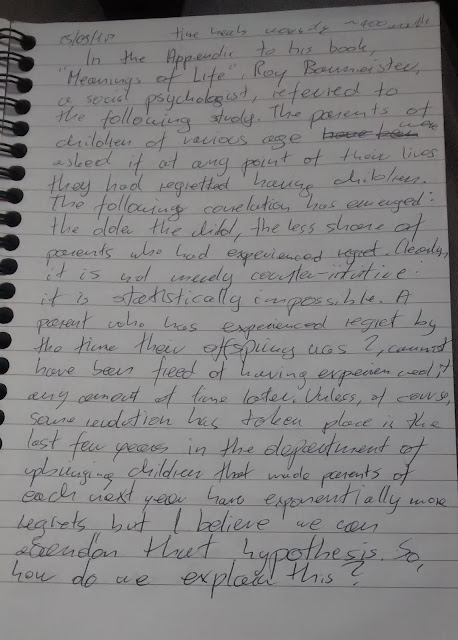
In the Appendix to his book, "Meanings of Life", Roy Baumeister, a social psychologist, referred to the following study. The parents of children of various age were asked if at any point of their lives they had regretted having children. The following correlation has emerged: the older the child, the less share of parents who had experienced regret. Clearly, it is not merely counter-intuitive: it is statistically impossible. A parent who has experienced regret by the time their offspring was 2, cannot have been freed of having experienced it any amount of time later. Unless, of course, some revolution has taken place in the last few years in the department of upbringing children that made parents of each next year have exponentially more regrets, but I believe we can abandon that hypothesis. So, how do we explain this?
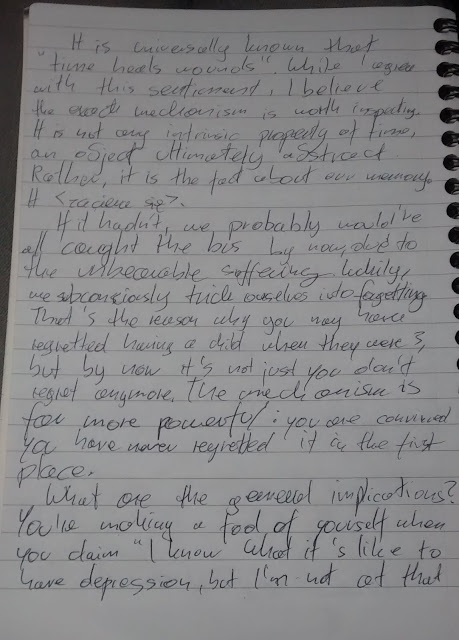
It is universally known that "time heals wounds". While I agree with this sentiment, I believe the exact mechanism is worth being inspected. It is not any intrinsic property of time, an object ultimately abstract. Rather it is the fact about our memory. It overwrites itself.
If it hadn't, we probably would've all caught the bus by now, due to the unbearable suffering. Luckily, we subconsciously trick ourselves into forgetting. That's the reason why you may have regretted having a child when they were 3, but by now it's not just you don't regret anymore. The mechanism is far more powerful: you are convinced you have never regretted it in the first place.
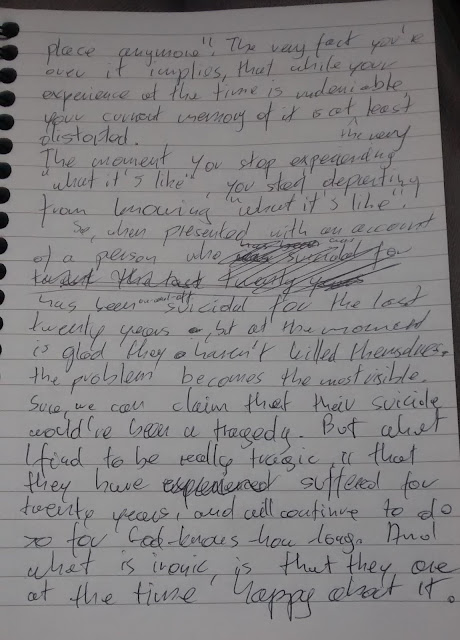
What are the general implications? You're making a fool of yourself when you claim "I know what it's like to have depression, but I'm not in that place anymore". The fact you're over it implies that while your experience at the time is undeniable, your current memory of it is at the very least distorted,
The moment you stop experiencing "what it's like", you start departing from knowing "what it's like".
So, when presented with an account of a person who has been off-and-on suicidal for the last twenty years, but at the moment is glad they haven't killed themselves, the problem becomes the most visible. Sure, we can claim that their suicide would've been a tragedy. But what I find to be really tragic is that they have suffered for twenty years, and will continue to do so for God-knows-how-long. And what is ironic, is that they are at the time happy about it.
It is universally known that "time heals wounds". While I agree with this sentiment, I believe the exact mechanism is worth being inspected. It is not any intrinsic property of time, an object ultimately abstract. Rather it is the fact about our memory. It overwrites itself.
If it hadn't, we probably would've all caught the bus by now, due to the unbearable suffering. Luckily, we subconsciously trick ourselves into forgetting. That's the reason why you may have regretted having a child when they were 3, but by now it's not just you don't regret anymore. The mechanism is far more powerful: you are convinced you have never regretted it in the first place.
What are the general implications? You're making a fool of yourself when you claim "I know what it's like to have depression, but I'm not in that place anymore". The fact you're over it implies that while your experience at the time is undeniable, your current memory of it is at the very least distorted,
The moment you stop experiencing "what it's like", you start departing from knowing "what it's like".
So, when presented with an account of a person who has been off-and-on suicidal for the last twenty years, but at the moment is glad they haven't killed themselves, the problem becomes the most visible. Sure, we can claim that their suicide would've been a tragedy. But what I find to be really tragic is that they have suffered for twenty years, and will continue to do so for God-knows-how-long. And what is ironic, is that they are at the time happy about it.


Friday, 5 October 2018
Saturday, 22 September 2018
self
Cioran napisał:
"Gdy inni przestali dla nas istnieć, sami przestajemy istnieć dla siebie"
Ja bym to sparafrazował:
Gdy przestajemy istnieć dla innych, przestajemy również istnieć dla siebie.
"Gdy inni przestali dla nas istnieć, sami przestajemy istnieć dla siebie"
Ja bym to sparafrazował:
Gdy przestajemy istnieć dla innych, przestajemy również istnieć dla siebie.
Thursday, 9 August 2018
czyny bez znaczenia
Przez Polskę po raz kolejny przetoczyłą się dyskusja na temat ewentualnego startu Donalda Tuska w wyborach prezydenckich – tym razem tych w roku 2020. Jakkolwiek ważny może być wpływ prezydenta na kraj, kandydatura czy też jej brak nie mają wielkiego znaczenia. Powód jest prosty: wybory prezydenckie to teatrzyk.
Udział w wyborach jako prawo tudzież obowiązek obywatela. Regularne głosowanie jako cnota. Kampania publiczna zachęcająca do pójścia do urn, z dowodem babci czy też własnym. Załamywanie rąk nad niską frekwencją. Mamy tu do czynienia z wartością bardzo ważną wizerunkowo, ale absolutnie nieznaczącej z pragmatycznego punktu widzenia.
Rozpatrzmy bowiem następujący przypadek: druga tura wyborów prezydenckich. Sprawdźmy, jakie jest prawdopodobieństwo, że nasz głos naprawdę będzie miał znaczenie, czyli będzie mieć decydujący wpływ na wynik wyborów. Głos, dzięki któremu nasz kandydat zremisuje zamiast przegrać lub wygra zamiast zremisować.
(Notabene, wiele mówi brak informacji o tym, co miałoby się stać w przypadku, gdyby remis rzeczywiście miał nastąpić - https://bezprawnik.pl/remis-w-wyborach-prezydenckich-taka-sama-liczba-glosow/ Wygląda na to, że samo państwo nie wierzy w to, że głos obywatela istotnie mógłby mieć znaczenie.)
Frekwencja w Polsce wynosi około 17 milionów. Możemy przeprowadzić symulację wyborów - tak właśnie przecież powstają prognozy wyborcze. Przypuśćmy, że każdy wyborca z danym prawdopodobieństwem wybiera jednego kandydata lub drugiego, niezależnie od innych wyborców, na przykład, że rzuca monetą. W tym wypadku, szansa, że nasz głos okazałby się decydujący, wynosi około 0.04%. To sporo.
Rzecz w tym, że tak równy rozkład jest wyjątkowo mało prawdopodobny, a rezultat jest wysoce podatny na niewielkie fluktuacje. Rozpatrzmy raczej inny scenariusz: jest 51% szans, że dany wyborca odda głos na kandydata A i 49%, że głos padnie na kandydata B. Sondaże doniosą nam o wyjątkowo wyrównanych wynikach: 51% do 49% czy też 49% do 51% z uwagi na błąd statystyczny. Zdawałoby się, że nasz udział w wyborach jest wyjątkowo ważny. Jednakże, prawdopodobieństwo, że nasz głos będzie miał znaczenie w tym wypadku, wynosi zaskakujące 1 do 5 razy 10 podniesione do 1481 potęgi. Czyli 0.000...5%, ale z jeszcze 1475 zerami w miejscu wielokropka.
Prawdopodobieństwo jest to tak małe, że nie jesteśmy go w stanie sobie wyobrazić. Podobnie prawdopodobne byłoby wygrać szóstkę w lotka 200 razy w ciągu 200 kolejnych losowań. Zaś wygranie 4 szóstek z rzędu już jest mniej prawdopodobne niż uduszenie się w nocy z powodu odpłynięcia całego powietrza do drugiej części pokoju z powodu chaotycznych ruchów cząsteczek. A przecież prawdopodobieństwo maleje wykładniczo.
To nie niedostatki demokracji są jednak głównym problemem; ten jest znacznie obszerniejszy, a powyższy przykład jest jedynie jego ilustracją. Można opisać go następująco: jesteśmy skłonni podejmować różne akcje, będąc przekonanymi o ich pozytywnych skutkach, podczas gdy te są właściwie nieobecne. Czy do działania motywuje nas zwyczaj, czy propaganda, warto zastanowić się, na ile nasze czyny rzeczywiście się liczą.
Nietrudno przecież o inny przykład akcji bez pokrycia. Wegetarianizm i weganizm są wyborami rok w rok zyskującymi na popularności, często podejmowanymi z pobudek etycznych. Problem: na ile mój osobisty wybór, żeby zrezygnować z jedzenia mięsa czy nabiału rzeczywiście wpływa na produkcję przemysłową? Czy to, że ja zamienię wołowinę na tofu zmniejszy podaż tej pierwszej? Czy rezygnacja ze słomek naprawdę uratuje jakiegokolwiek żółwia? Oszacowanie tego jest praktycznie niemożliwe.
Nie chodzi jednak o to, żeby stwierdzić, że nic nie ma sensu. Nie twierdzę też, jakoby miałoby być cokolwiek złego w działaniu nastawionym na dobro, nawet jeśli jego efekty są mizerne. Oczywiście, że lepiej robić coś niż nie robić nic.
Rzecz w tym, żeby przekonanie o naszej własnej dobroci nie przesyciło naszej świadomości. Dużo łatwiejszym jest utrzymywanie wysokiego mniemania o wartości swoich czynów niż rzeczywiste działanie.
Jak więc poradzić sobie z tą niemocą, która pomimo naszych najlepszych wysiłków i fałszywych przekonań, pokrywa nasze akcje? Wierzę, że odpowiedzią może być aktywizm.
Paradoksalnie, napisanie powyższego artykułu może mieć większy wpływ na polską politykę niż to, jak często ja sam chodzę na wybory i na kogo oddaję swój głos. Tak samo, wspieranie opisywanych w 499. numerze Kultury Liberalnej “Otwartych Klatek” może mieć dużo większy wpływ na sytuację zwierząt niż osobisty wybór diety – przynajmniej pomijając możliwy efekt domina diety własnej na dietę bliskich osób. Jakkolwiek paradoksalnie by to nie zabrzmiało, wzorem do naśladowania mógłby być ten, kto z mięsa nie rezygnuje, przekazuje natomiast część pieniędzy na dotacje. Oczywiście, że nie jest to zachowanie idealne. Ale nie ma w nim hipokryzji, a raczej odstręczająco chłodna kalkulacja.
Pomimo bycia społeczeństwem przesiąkniętym mesjanizmem do głębi, może się okazać, że to nie osobistymi wyrzeczeniami prowadzi droga do lepszego świata.
notes on homicide
Homicide - Martin Daly, Margo Wilson, 1988.
Evolutionary psychology - belief that the natural selection has been able to act on psychology as well, thus creating certain psychological adaptations p. 6
Kinfolks - much more likely to help in a homicide than be a victim of one; it is surprisingly often spouses/nonrelatives that are killed p. 23
Infanticide - probability decreases with mother’s age p.63

Females do not kill spouses and children; they kill children more often than males p. 83

Stepparents pose great risk to the child p. 92
Folktales as manipulative devices - promoting virtues that serve the elders p. 118
Same-sex bias in parent-offspring homicides p. 120
Polygynous marriage - legitimate in 93% of 849 societies (Murdock ethnographic atlas) p. 132
“A well-guarded harem of nubile women is the realization of a male fantasy. It is a fantasy that has apparently arisen in men’s minds repeatedly and independently in a variety of cultures, and has been so appealing as to be implemented again and again, at great expense, when men have somehow amassed the means to do so. It is the fantastic aspiration of a male psyche with a natural selective history” p. 135
“It is in such a social milieu that man’s psyche was shaped, a psyche obsessed with social comparisons, with the need for achievement, and with the desire to gain control over the reproductive capacities of women” p. 136
“Our point is not to blame the late Dr. Mead for the liberties that others have taken with the myth she created. What is of interest is how t h e m y t h f i l l s a n e e d for social scientists and commentators. It seems to demonstrate that our social natures are pure cultural artifacts, as arbitrary as the name of the rose, and that we can therefore create any world we want, simply by changing our ‘socialization practices’ (this may sound a remarkably totalitarian vision, but it’s not, you see, because the new, improved socialization practices will be designed by n i c e people with everyone’s best interests at heart, and not by nasty, self-interested despots.) The social science that is used to legitimize this ideology can only be described as b i o p h o b i c.” pp. 153-154
Correlation of monogamy and jealousy - due to the costly risk of being cuckolded p. 181
Dowry exists in 22 out of 860 societies p. 189
Adultery law invariably applies only to married women in its fullest because of the risk of cuckoldry again p. 193
“There is a great difference between the offence of infidelity in a man and that of his wife” / “the difference is boundless. The man imposes no bastards upon his wife” p. 193
Adultery and a physical assault on the person/their relatives - the only provocations that mitigate so much killer’s criminal responsibility p. 196
Jealousy/adultery as the main reason behind spousal homicides p. 202
“But is there even one exotic land in which the men eschew violence, take no proprietary view of their wives’ sexuality, and accept consenting extramarital sex as good, clean fun? The short answer is “No,” although many have sought such a society, and a few have imagined that they found it.” p. 203
Strong correlation between wife's’ infidelity and husband’s engaging in domestic violence p. 208
“If these lethal May-December marriages are beginning to strike you as improbably frequent, you are right: They are. p. 209

“Another possible explanation [for the homicide/age difference correlation] is that the population of couples with unusual age differences, like any population defined by unusual behavior, contains a disproportionate number of eccentrics, losers and misfits” p. 210
[on familicide with suicide] “this sort of case illustrates with particular clarity just why we insist that adaptation must be sought at a more psychological level than that of direct behavioral optimization and fitness maximization. A rational fitness-maximizer would surely let the children live, for even if he doubted their paternity, they might, after all, be his. But fitness is not the man’s most proximal concern.” p. 215
The probability of suicide after homicide is greatly increased if the victim was female. p. 218
“Killing those outside the social contract is likely to be no offense at all. In most human societies throughout history, foreigners have been fair game. And of course war is a socially sanctioned cooperative act in which killing (the right targets) is not culpable at all, but laudable. The trick is that the rules can get changed retrospectively, especially if your side loses.”
“Insanity is the loss of normal perceptions of one’s interests and/or of the inclination to pursue them”
“The human brain/mind is ‘anything but a mechanism set up to perceive the truth for its own sake’” Michael Ghiselin 1974
“So excess in revenge is a constant temptation and a not infrequent reality. ‘An eye for an eye’ is not so much the articulation of the revenge motive as it is a m o r a l i n j u n c t i o n to equity - an attempt to c o n t a i n violence. But an attempt by whom, and in whose interest?”
Further reading:
Male sexual jealousy - Daly, Wilson, Weghorst, (1982)
The Adapted Mind - Cosmides, Tooby, Barkow (1992)
Subscribe to:
Posts (Atom)